
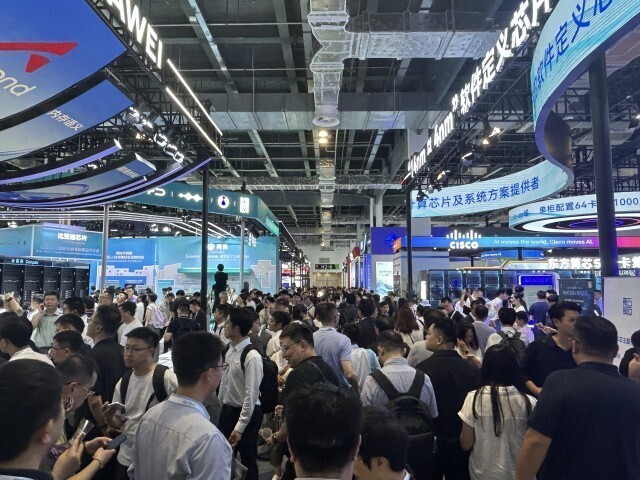
While the World Artificial Intelligence Conference was in full swing in Shanghai, a campaign to collect exhibitor business cards began! Collection is just the first step; the second step is to start peddling these cards.
Actually, collecting exhibitor business cards at exhibition venues is not limited to just one event. Well-known exhibitions all have similar situations. It is just that WAIC was particularly hot and the topic was relatively new.
But the reality is: are those thick stacks of business cards actually useful? How many orders with real money can they ultimately convert?
Actually, this question has another meaning: is participating in exhibitions useful? This has become the common refrain of exhibitors in the post-pandemic era.
The answer may make most people uncomfortable: business cards collected at exhibitions are mostly wasted from the moment they are collected.
Note the keyword: mostly, not all.
There is another question: people do not use business cards much anymore, so does it make sense to talk about their value? Actually, regardless of the era, communication requires exchanging contact information. That topic is not within the scope of this article.
The value simply depends on who you are, how you obtained them, and what you do after getting them.
[Business Cards Through the Eyes of Visitors]
There are two types of exhibition business cards: those collected by visitors and those collected by exhibitors.
Let us start with visitors. At each booth front desk, salesperson business cards are usually displayed. To different visitors, these cards mean completely different things.
For professional visitors with procurement or cooperation needs, these cards are golden channels. They visit exhibitions to find suppliers, compare products, and discuss cooperation. The business cards they pick up at booths become contactable entry points. They can use them later for price comparison, inquiries, and delivery schedules. Those seeking cooperation can also continue their exchanges. For these visitors, the business cards themselves have practical value as traceable contact credentials.
In contrast, for other visitors, booth business cards are basically waste paper. For example, booth builders soliciting clients, fellow exhibition salespeople poaching exhibitors, media seeking advertising partnerships, or even lunch box sellers. Most of the business cards received at booths go to company sales teams, but the card owners are not their target customers at all.
So the same booth, the same business cards, in different hands, the value is worlds apart.
[Business Cards Through the Eyes of Exhibitors]
Now let us talk about exhibitors. Everyone who has participated in an exhibition has seen this scene: a business card box at the front desk with a sign saying Please leave your card. Some even offer a lucky draw. Visitors drop a card to get a gift or a chance to win a prize. The booth is packed, and the card box fills up in half a day.
Obviously, these cards have little to do with business. They are like WeChat Official Account subscribers: the numbers look impressive, but most have never clicked on your articles.
This is the first type of business card at exhibitions: the lucky draw Please leave your card, high volume, low cost, easy to obtain. But essentially, the other party exchanged a card for a freebie. They may not be your target customer, may not have procurement needs, and might even be industry peers just here for a free lunch.
However, exhibitors have a second type of business card: procurement leads exchanged after business talks. In meeting rooms or negotiation areas within the booth, both sides engage in in-depth discussions about products, needs, and quotes before exchanging cards. The other party understands your product, expresses cooperation intent, and has a clear procurement cycle and budget range.
The gap between the two types is not a difference in quantity, but in quality.
[Let Data Speak: The Real Conversion Rate of Business Cards]
In a medium-to-large exhibition, business cards collected at booth front desks typically account for 60 to 80 percent of the total.
Taking a B2B professional exhibition as an example, a standard booth can collect 300 to 500 business cards over a three-day exhibition, of which over 70 percent are obtained through shallow interaction methods like lucky draws and scan-to-follow.
What is the real conversion rate of business cards?
Effective contact rate is less than 40 percent. Many cards have incomplete information, mismatched job titles versus actual purchasing authority, or companies outside the target industry.
Intent rate does not exceed 10 percent. This is also the root cause of most exhibitors feeling that exhibiting is useless. The cards in the lucky draw box mostly come from salespeople, peers, and freebie-seekers. Very few have genuine procurement intent.
Final transaction rate approaches zero. Industry experience shows that the probability of directly converting lucky draw cards into orders is below 0.5 percent.
One company spent three days collecting 400 business cards, of which 280 came from the lucky draw box. Fewer than 50 could actually be reached by phone to confirm needs, and the final transactions were probably only 1 to 2 companies.
It is not the business cards fault. The collection method determined their low quality from the very beginning.
[What Makes a Business Card Valuable?]
Back to the exhibitors second type of business card: procurement leads exchanged after business talks. These typically account for only 20 to 30 percent of the total, but their conversion logic is completely different.
Small in number, but they are the real business opportunities.
The value of these leads lies in the context: you know which product they are interested in, understand their procurement cycle, know their budget range, and have even met their decision-making team members.
This information volume is something lucky draw cards simply cannot provide.
But even high-quality leads do not convert automatically.
The reality is that many companies spend a week or more after the exhibition organizing business cards, entering them into systems, and following up with clients. By the time the first follow-up email goes out, the client has long forgotten who you are.
About 63 percent of high-quality exhibition leads are lost within 48 hours after the show due to untimely follow-up.
More critically, many companies mix lucky draw cards and negotiation leads in the same spreadsheet, with no segmentation or prioritization.
Salespeople spend massive time dialing invalid numbers from lucky draw cards, while neglecting the negotiation clients who should be prioritized.
[Are Business Cards Useful?]
Business card value depends on three variables:
Business Card Value = Collection Method x Collector Identity x Follow-up Action
All three variables are essential:
Collection Method: Front-desk lucky draw cards are extremely low quality; negotiation leads are high quality.
Collector Identity: The same card is an asset in the hands of a procurement visitor comparing prices, but just waste paper in the hands of a peer salesperson.
Follow-up Action: Even high-quality leads become waste paper if not followed up within 48 hours; even a pile of cards can yield gold if processed in layers.
A proven effective approach:
Pre-exhibition: Lock in 15 to 30 high-quality face-to-face meeting targets through appointments; focus energy on meeting the right people rather than collecting cards.
During exhibition: Collect lucky draw cards separately, only for brand exposure and prize redemption; for negotiation leads, record key discussion points on the spot and mark priorities the same day. Procurement visitors should proactively collect cards from target booths, focusing on recording product models and pricing information.
Post-exhibition: Handle the two lists separately. Lucky draw cards enter an automated email marketing pool for low-cost, long-term nurturing; negotiation leads are followed up individually within 24 hours, with the first round of in-depth communication completed within 7 days.
Data shows that companies adopting this layered strategy can improve overall exhibition lead conversion rates by 3 to 5 times, reducing the effective customer acquisition cost per lead from 5,000 to 8,000 yuan to 800 to 1,500 yuan.
Are exhibition business cards useful? The answer is more complex than most people imagine.
Next time the exhibition ends and your team returns to the office with a thick stack of business cards, why not do one thing first: sort them into categories. Probably only the thinnest third of them are the real business opportunities worth following up on.