
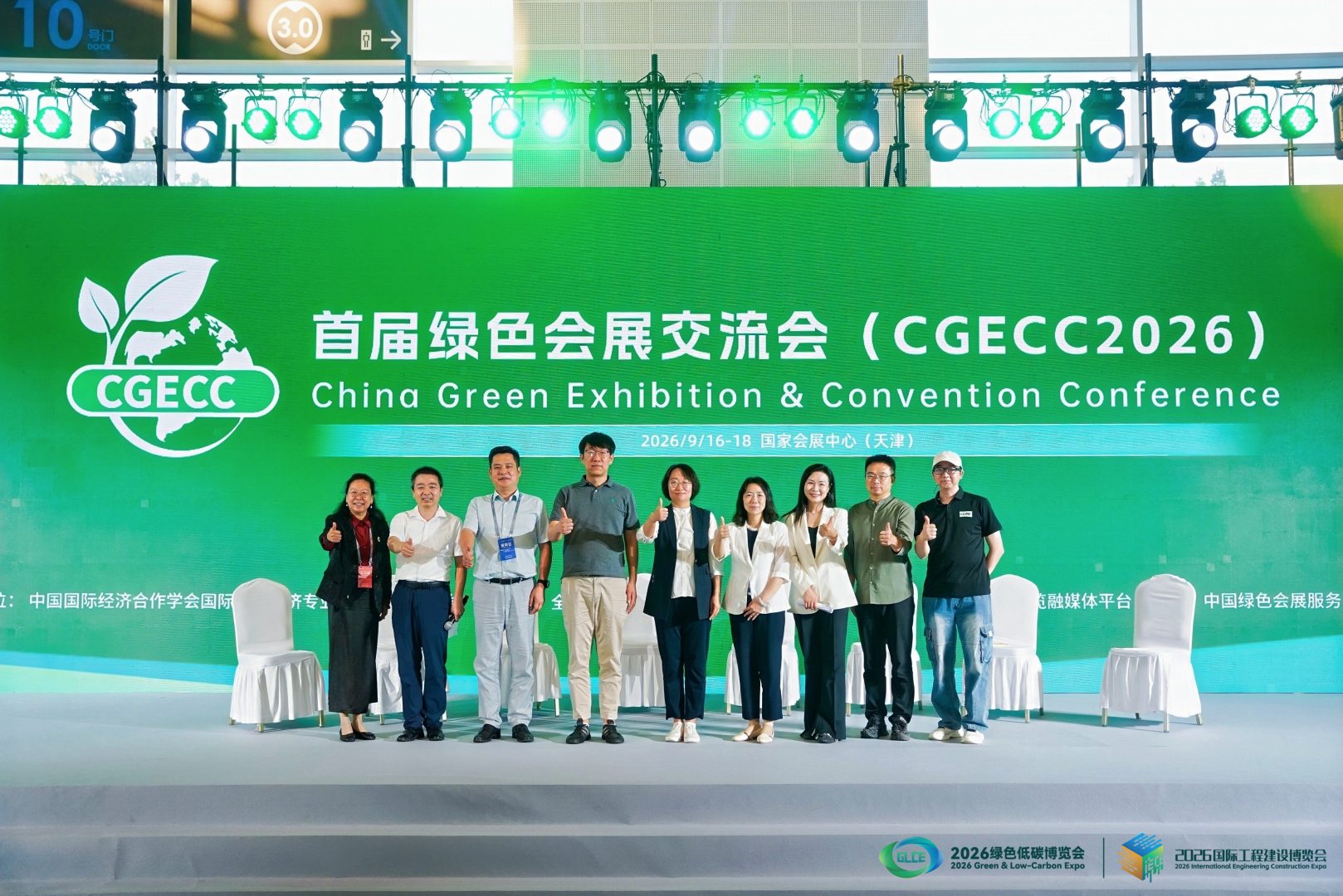
On the afternoon of September 17, as a core thematic program of the inaugural China Green Exhibition & Convention Conference (CGECC2026), two parallel sessions on green exhibition construction and green industry-education integration continued at the National Convention and Exhibition Center (Tianjin). More than 100 representatives from exhibition industry service providers, universities, venue operators and industry associations attended. The event was co-hosted by the International Exhibition Economy Committee (IEEC) of the China Society for International Economic Cooperation, the Exhibition Working Committee of the National Federation of Urban Industrial Products Trade Centers, the Global Expo converged media platform, and the China Green Exhibition Service Platform, and organized by the National Industry-Education Integration Community for High-Quality Exhibition Development, the Beijing-Tianjin-Hebei Exhibition Education Alliance, and the Green Exhibition Innovation Center.
As one of the conference's most closely followed forums, the program progressed logically from green practice benchmarks at top international exhibitions, to the strategic direction of the global net-zero transition, to the commercial application of new green materials and equipment, and finally to the long-term mechanism for talent cultivation and industry-education collaboration, presenting a complete and actionable roadmap for the green transformation of the exhibition industry. Originally scheduled to end at 17:00, the sessions ran until 17:30 amid lively discussion, with many attendees continuing to exchange views with speakers until the venue closed.
During the event, many enterprise representatives proactively met with faculty members to discuss curriculum development, student training bases, technology on campus, joint research projects, standards building and teacher training, reaching a number of preliminary cooperation intentions and realizing on-site matching between green industry resources and educational resources.
Li Qi, Executive Director of Pico Beijing and Vice Chairman of the Beijing International Convention and Exhibition Industry Association, delivered a speech titled "How Exhibition Professionals Practice Green Exhibitions," sharing the full-chain green experience of Sibos Beijing 2024. As one of the world's three premier financial events alongside Davos and the G20 financial summit, Sibos was held in the Chinese mainland for the first time in 44 years, with green event standards representing the highest global practice.
Li Qi broke down the project's carbon-reduction pathways across five dimensions: travel and transport, stand construction, public services, catering, and venue power. Through official shuttle buses and a dedicated mechanism to offset residual emissions, per-capita carbon emissions fell 10% compared with the previous edition. PVC, KT boards and other highly polluting materials were banned in construction, replaced entirely by ENF-grade eco particleboard, vertical corrugated plant-fiber board and formaldehyde-free tea-scented board; all reusable meeting facilities were handed over to the China National Convention Center for reuse at the subsequent WGC exhibition. Lightweight solutions such as paper folding screens and osmanthus plant landscaping were adopted for venue services. The project was highly recognized by Beijing municipal leadership, and its experience was promoted citywide as a model for green large-scale events in the capital.
Li Qi stressed that green exhibitions are not synonymous with "crude": through modular design and creative expression, striking visual effects can be achieved while meeting carbon-reduction goals, truly realizing the idea that "once the concept changes, reuse becomes an honor."
Huang Yuan, researcher at the CCPIT Commercial Sub-council and expert of the China working group for Net Zero Carbon Events (NZCE), gave a keynote titled "Toward Net-Zero Carbon Exhibitions: Practice and Exploration of the Green and Low-Carbon Transformation." Tracing the origins of global net-zero action, she introduced the Net Zero Carbon Events initiative launched in 2021 under the UN framework by JMIC together with UFI, AIPC and other international organizations, setting the industry's shared goal of net-zero emissions by 2050. She noted that China's exhibition industry is moving from scattered green measures toward systematic lifecycle carbon management, with digital tools and international standards becoming core supports.
Huang Yuan highlighted Chinese experts' breakthrough in international exhibition standardization: the ISO/TC 354 working group on business events is convened by a Chinese expert and has begun developing international standards on terminology, waste management and PCO services, with China evolving from a standards follower to an important rule-maker. At the event she also launched the call for the "China Exhibition Industry Net Zero Carbon Events Best Practice Cases (2026)," seeking replicable and scalable net-zero cases across the industry.
Zhang Zhenqiang, General Manager of Hangzhou Bailuda New Materials Technology, presented "Paper-Based Green Exhibition, A Promising Future," showcasing the large-scale application of paper-based plant-fiber materials in exhibition settings. Noting that the industry long regarded green materials as "expensive, weak and impractical," he said Bailuda has developed vertical corrugated paper-based materials with B1-grade fire resistance, long-span load-bearing capacity and waterproof durability through continuous R&D, fundamentally breaking through the engineering bottleneck of paper materials.
Comparison data showed that paper-based materials of the same specification weigh only one-sixth of traditional wood boards, cutting construction labor costs by 83%, transport costs by 70%, construction time by 50%, while raising processing efficiency by 80%, with 100% of the material recyclable into paper. The overall cost of a custom-built booth can fall by 30%, and secondary-use cost by 70%. The materials have been applied in hundreds of projects, including the Hangzhou Asian Games Zero-Waste Living Hall, the Huawei Developer Conference, the SF Zero-Carbon Exhibition, CITIC Bank showrooms and the Shanghai Daily Necessities Fair. Zhang Zhenqiang said paper-based green exhibition is not a temporary environmental gimmick but a mature solution with a complete industrial chain ready for large-scale rollout.
Sun Xiaoqiu, Chairman of Changzhou Hawk Display Systems, unveiled the third generation of green eco exhibition equipment, an integrated modular quick-installation display system. Describing it as "making booth building as simple as playing with Lego," he said all components use standardized design for rapid assembly without complex on-site construction, and can be fully recycled and reused after dismantling, fundamentally solving the problem of large amounts of construction waste from one-off traditional booths and upgrading the green concept from "material substitution" to "system reuse," representing an important direction for greener exhibition equipment.
Professor Yang Qi, Director of the Exhibition Research Institute of Tianjin University of Commerce and Secretary-General of the National Modern Exhibition Industry-Education Integration Community, spoke on "Industry-Education Integration Pathways for Green Exhibition Talent Cultivation." Starting from top-level designs such as the national 15th Five-Year Plan carbon-peaking action plan and the Ministry of Commerce's implementation opinions on expanding green trade, he pointed out that one of the biggest bottlenecks in the industry's green transition is the talent gap, with rising demand for interdisciplinary green exhibition professionals who understand design, operations and carbon accounting. Analyzing pain points such as difficulty integrating cross-disciplinary knowledge, the gap between theory and practice, and fragmented curricula, he proposed building a green exhibition education system covering the entire industrial chain, with industry and universities jointly building industry colleges and practice bases and co-developing textbooks and curricula to precisely connect the education chain with the industrial chain.
Liang Jianfeng, a core member of the National Industry-Education Integration Community for High-Quality Exhibition Development and director of the supervision and research office of Beijing Foreign Trade School, shared how the community is driving industry-education integration. He said the community now brings together nearly 50 universities, vocational colleges, industry associations and leading exhibition enterprises across the country's core exhibition cities, having established collaborative education vehicles such as the Capital Convention and Exhibition Service Management College, developed eight professional textbooks, launched the country's first exhibition-sector mutual-recognition scheme covering vocational skill certificates, enterprise certification, professional titles and international certificates, and organized training for over 1,000 participants. He said the community will next take green exhibitions as a core direction, connecting with green technology and materials companies and working with universities to develop specialized green exhibition courses and training systems.
In the subsequent roundtable, moderated by Professor Yang Qi, heads of exhibition programs from Beijing City College, Tianjin College of Commerce, Beijing Institute of Graphic Communication and Hebei University of Environmental Engineering, together with green materials enterprise representatives including Zhang Zhenqiang, Liang Jianfeng and Dong Jun, deputy director of the Green Exhibition Innovation Center, discussed how green exhibitions can align industry demand with talent cultivation, how new green materials and equipment can enter university teaching, and how industry-education integration can ease the green-transition cost burden for small and medium exhibition enterprises. Faculty expressed expectations for deeper involvement of green exhibition enterprises in school-enterprise cooperation, while enterprise representatives welcomed long-term partnerships to co-develop curricula and training bases.
Dong Jun put forward a theory of four "sources" for green exhibition development, calling for systematic efforts from the sources of policy, standards, materials and education, which he said are core directions requiring sustained work. He stressed that the Green Exhibition Innovation Center will serve as a bridge, opening up channels between enterprises and universities to promote two-way empowerment of industry and education.
The event was moderated by Ying Lijun, Deputy Chair of IEEC and Deputy Director of the Academic Committee of the China Convention and Exhibition Economy Research Association. Participants said the program clearly addressed the core questions of why, how and by whom green exhibitions should be conducted, from international benchmarks to local practice and from technology products to talent cultivation. Next, the organizers will continue to gather resources across the green exhibition value chain, promote the application of technological achievements and coordinated talent cultivation, and provide solid support for the comprehensive green transformation of China's exhibition industry.